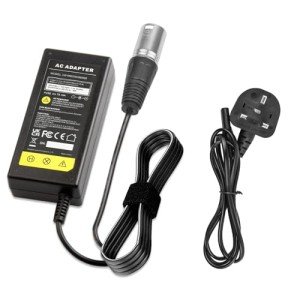
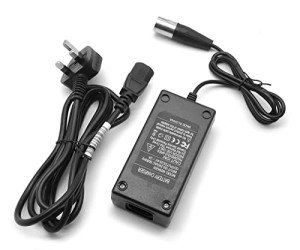
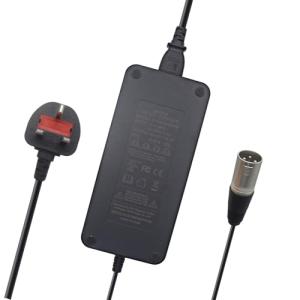
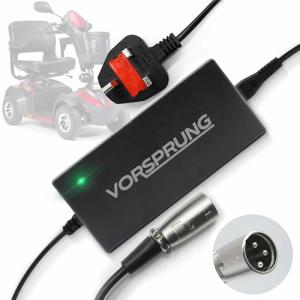
For individuals who rely on mobility scooters for their daily independence, the battery charger is arguably the most critical accessory in their repertoire. Among the various power options available, the 24V 8AMP Mobility Scooter Battery Charger with an XLR Plug stands out as a high-performance solution designed for larger scooters and heavy-duty power needs. This guide explores the technical specifications, safety features, usage best practices, and maintenance requirements of this essential piece of equipment.
Understanding the Specifications: 24V and 8AMP
To understand why an 8AMP charger is significant, one must first understand the relationship between voltage and amperage.
- 24V (Voltage): Most modern mobility scooters operate on a 24-volt system, typically powered by two 12-volt batteries connected in series. A 24V charger is precisely calibrated to provide the electrical pressure necessary to push energy back into these batteries.
- 8AMP (Amperage): Amperage represents the speed of the current. While many standard chargers offer 2A or 5A, an 8AMP charger provides a faster "fast-charge" capability. This level of output is generally reserved for large, heavy-duty scooters (Class 3) or those equipped with high-capacity batteries (often 30Ah to 100Ah).
Technical Comparison Table
The following table summarizes the typical specifications for a professional-grade 24V 8AMP charger.
| Feature | Specification |
|---|---|
| Input Voltage | 100-240V AC (Auto-sensing for global use) |
| Output Voltage | 24V DC (Nominal) |
| Charging Current | 8 Amperes |
| Connector Type | 3-Pin XLR (Male) |
| Cooling System | Forced Air (Internal Fan) |
| Compatible Battery Types | AGM, Gel, Lead-Acid (SLA) |
| Safety Certifications | UL, CE, FCC, RoHS |
The XLR Plug: The Industry Standard
The XLR plug, characterized by its circular shape and three distinct pins, is the universal standard for mobility scooter charging ports. The configuration is specifically designed to prevent accidental short circuits.
- Pin 1: Usually the Positive (+) terminal.
- Pin 2: Usually the Negative (-) terminal.
- Pin 3: Often used as an "Inhibit" pin, which prevents the scooter from driving while the charger is plugged in.
This standardized design ensures that users do not have to struggle with proprietary connectors, allowing for greater compatibility across various brands such as Pride Mobility, Drive Medical, Golden Technologies, and Invacare.
Smart Charging: The 3-Stage Process
Contemporary 24V 8AMP chargers are not simple "trickle" devices; they use sophisticated microprocessors to manage a 3-stage charging cycle. This process ensures the batteries are filled efficiently without causing damage through overheating or overcharging.
- Bulk Charge Stage: The charger provides a constant 8AMP current to bring the battery up to approximately 80% capacity as quickly as possible.
- Absorption Stage: The voltage is held constant while the current (Amperage) gradually decreases. This stage "tops off" the battery safely to reach 100%.
- Float/Maintenance Stage: Once the battery is full, the charger drops to a very low voltage. This keeps the battery at 100% capacity without boiling the electrolyte or causing plate sulfation.
Charging Time Estimates
The time required to charge a mobility scooter depends on the Amp-hour (Ah) rating of the batteries. An 8AMP charger is significantly faster than standard 2AMP or 5AMP models.
| Battery Capacity (Ah) | Approx. Time with 2A Charger | Approx. Time with 5A Charger | Approx. Time with 8A Charger |
|---|---|---|---|
| 35 Ah | 17.5 Hours | 7 Hours | 4.5 Hours |
| 55 Ah | 27.5 Hours | 11 Hours | 7 Hours |
| 75 Ah | 37.5 Hours | 15 Hours | 9.5 Hours |
| 100 Ah | 50 Hours | 20 Hours | 12.5 Hours |
Note: These times are estimates based on a 100% discharge, which is not recommended for battery longevity.
Key Benefits of Using an 8AMP Charger
Choosing a high-amperage charger like the 8AMP model provides several advantages for heavy users:
- Reduced Downtime: Users can return to their activities faster, which is vital for those who use their scooters for primary transportation.
- Efficiency for Large Batteries: Large batteries (over 50Ah) actually require higher amperage to prevent sulfation, a process where lead sulfate crystals build up on the battery plates.
- Built-in Cooling: Due to the high current, these chargers feature internal cooling fans that prevent the internal components from overheating, extending the life of the charger itself.
Safety Features to Look For
When purchasing a 24V 8AMP charger, certain safety protocols are non-negotiable. Quality chargers incorporate the following:
- Short Circuit Protection: Prevents sparks or fires if the output terminals are accidentally crossed.
- Over-Current Protection: Limits the flow of electricity if the battery demands more than the charger can safely provide.
- Over-Voltage Protection: Ensures the voltage does not spike and damage the scooter's sophisticated electronics.
- Reverse Polarity Protection: Protects the system if the battery is connected incorrectly.
- Auto-Shutoff: The ability to stop charging once the batteries reach maximum capacity.
Best Practices for Charging and Maintenance
To maximize the lifespan of both the 8AMP charger and the scooter's batteries, users should follow a strict maintenance regimen.
The Do's of Charging
- Charge Daily: Even if the scooter was only used for a short distance, it is best to plug it in overnight.
- Ventilation: Always charge the scooter in a well-ventilated area to allow the charger's fan to dissipate heat effectively.
- Sequence: Plug the charger into the scooter first, then plug the charger into the wall outlet.
- Use the Right Type: Ensure the charger is compatible with the specific chemistry of the battery (AGM vs. Gel).
The Don'ts of Charging
- Avoid Deep Discharge: Do not wait until the battery is completely dead to charge it. Try to charge when the battery meter reaches 30-40%.
- No Extension Cords: Avoid using long extension cords, as they can cause a drop in voltage and lead to overheating.
- Avoid Extreme Temperatures: Do not charge in freezing conditions or direct sunlight.
Troubleshooting Common Issues
If the 8AMP charger fails to operate, the following steps can help identify the problem:
- Check the LED Indicator: Most chargers have a light system (e.g., Red for charging, Green for full, Flashing for error).
- Inspect the XLR Pins: Look inside the plug to ensure none of the three pins are bent, burnt, or corroded.
- Wall Outlet Check: Verify the wall outlet is functioning by plugging in another appliance.
- Inhibit Switch: Ensure the scooter is turned off. Most chargers will not engage if the scooter's ignition is in the "On" position.
Frequently Asked Questions (FAQ)
Q: Can I use an 8AMP charger on a small travel scooter?
A: Generally, no. Small travel scooters usually have 12Ah to 18Ah batteries. Charging them at 8AMPs can cause the batteries to overheat and significantly shorten their life. Small scooters should stick to 2AMP or 5AMP chargers.
Q: Why does the charger get hot during use?
A: It is normal for the charger to become warm as it converts AC power to DC power. The internal fan should be running to mitigate this. If it is too hot to touch, disconnect it immediately.
Q: Can I leave the charger plugged in all the time?
A: High-quality 3-stage chargers have a "float mode" that allows them to remain connected safely. However, it is generally recommended to unplug the charger once a full charge is achieved if the scooter will not be used for several days.
Q: How do I know if my batteries are bad or if the charger is broken?
A: If the charger stays on "Red" for more than 15 hours without turning "Green," the batteries likely have a dead cell. If the charger's light never turns on at all, the charger itself probably has a blown internal fuse or a failed component.
The 24V 8AMP Mobility Scooter Battery Charger with XLR Plug is a powerhouse accessory that provides efficiency and reliability for heavy-duty mobility users. By understanding the 3-stage charging process and following safety protocols, owners can ensure their scooters remain ready for any journey. Investing in a high-quality charger is not just about maintaining a machine; it is about protecting the freedom and independence that a mobility scooter provides.