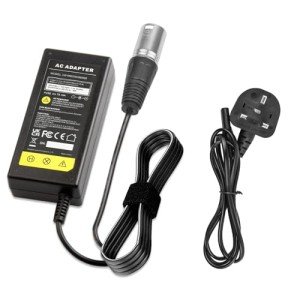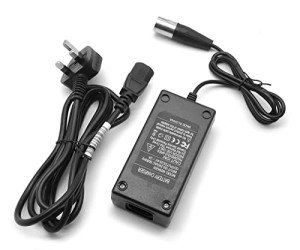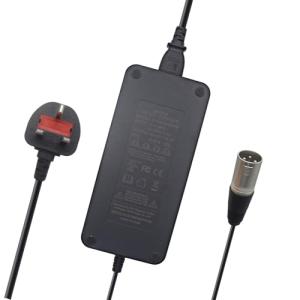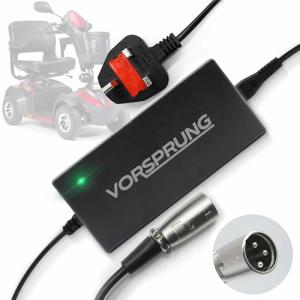

For individuals who rely on mobility scooters and electric wheelchairs, independence is inextricably linked to the reliability of their equipment. At the heart of this reliability lies the battery and, by extension, the charging system. The 29V 5A charger has emerged as a gold standard for many modern mobility aids, offering a balance of rapid charging and battery longevity.
This guide provides an in-depth look at the technical specifications, benefits, and safety considerations of the 29V 5A charger, ensuring users and caregivers can make informed decisions regarding their equipment maintenance.
Understanding the Technical Specifications
To understand why a 29V 5A charger is chosen for mobility devices, one must first understand the relationship between voltage and amperage. Most mobility scooters operate on a 24V system, typically powered by two 12V batteries connected in series. A charger must provide a higher voltage than the battery's nominal rating to "push" energy back into the cells. This is why a "24V charger" actually outputs approximately 29 volts during the peak of its charging cycle.
The "5A" refers to the amperage, or the speed at which the current flows. A 5-amp charger is considered a "high-output" charger compared to the standard 2-amp models often included with smaller portable scooters.
Key Technical Specifications Table
| Feature | Specification |
|---|---|
| Input Voltage | 100-240V AC (Universal Compatibility) |
| Output Voltage | 29V - 29.4V DC |
| Output Current | 5.0 Amperes |
| Connector Type | Usually 3-Pin XLR (Male) |
| Battery Compatibility | Lead-Acid (SLA, AGM, Gel) or specific Lithium-Ion |
| Charging Stages | 3-Stage (Bulk, Absorption, Float) |
| Safety Certifications | UL, CE, RoHS, FCC |
The Advantages of a 5A Charging Output
Choosing a 5A charger over a lower-amperage alternative offers several distinct advantages for the daily user.
1. Reduced Charging Time
The most immediate benefit is speed. A standard 2A charger might take 10 to 12 hours to fully replenish a large 35Ah or 50Ah battery set. A 5A charger can theoretically perform the same task in less than half the time. This is crucial for individuals who use their scooters throughout the day and need a midday "top-off" or for those who forgot to plug in their device overnight.
2. Efficiency for Larger Batteries
Larger, heavy-duty mobility scooters and power chairs designed for outdoor use often have high-capacity batteries. A low-amp charger may struggle to push these batteries to a full state of charge, leading to "sulfation" in lead-acid batteries. The 5A output provides enough "punch" to ensure the chemical reaction within the battery is completed efficiently.
3. Integrated Smart Technology
Most modern 29V 5A chargers are "smart" chargers. They do not simply pump electricity into the battery at a constant rate. Instead, they follow a sophisticated three-stage process:
- Bulk Stage: High current is delivered to bring the battery to 80% capacity quickly.
- Absorption Stage: The voltage remains constant while the current tapers off to safely reach 100%.
- Float Stage: The charger drops to a very low voltage to maintain the charge without overcharging or "cooking" the battery.
Compatibility and Connection
The 29V 5A charger is almost universally equipped with a 3-Pin XLR connector. This circular plug is the industry standard for the mobility market. However, it is essential to verify the pin configuration. In the vast majority of cases:
- Pin 1: Positive (+)
- Pin 2: Negative (-)
- Pin 3: Inhibit/Ground (This pin often tells the scooter to "lock" its motor so it cannot be driven while plugged in).
List of Compatible Device Types
- Heavy-Duty Power Wheelchairs: Devices meant for full-day use.
- Full-Size Mobility Scooters: 3-wheel and 4-wheel models with larger frames.
- All-Terrain Mobility Aids: Vehicles requiring high-capacity energy storage.
- Patient Hoists: Some medical lifting equipment utilizes the 24V/29V charging standard.
Safety Features to Look For
When purchasing a replacement or upgrade charger, safety should be the primary concern. Since these devices handle significant electrical current, high-quality builds are non-negotiable.
- Over-Voltage Protection (OVP): Prevents the charger from outputting too much voltage, which can cause battery swelling or fire.
- Short-Circuit Protection (SCP): Automatically shuts down the unit if a short is detected in the cable or the device.
- Thermal Protection: Many 5A chargers include internal cooling fans. If the unit overheats, it should have a sensor that reduces output or shuts off until it cools down.
- Reverse Polarity Protection: Protects the charger and the battery if the connections are somehow reversed.
Best Practices for Battery Maintenance
To maximize the lifespan of both the 29V 5A charger and the scooter's batteries, users should follow a set of established maintenance protocols.
- Charge Every Night: Lead-acid batteries (the most common type in scooters) do not have a "memory effect." They prefer to be kept full. Frequent shallow discharges are better than deep discharges.
- Avoid Extreme Temperatures: Do not charge batteries in freezing cold or sweltering heat. Room temperature is ideal for chemical stability during the charging cycle.
- Plug into the Scooter First: It is often recommended to plug the charger into the scooter's charging port before plugging the charger into the wall outlet to avoid minor arcing.
- Verify the LED Indicators: Most 5A chargers use a Red/Green light system.
- Solid Red: Charging in progress.
- Solid Green: Charging complete/Float mode.
- Flashing Red: Error (Check connections or battery health).
Comparing Amp Ratings: 2A vs. 5A vs. 8A
The following table compares different charger outputs to help users understand where the 5A model fits in the market.
| Charger Rating | Best Use Case | Benefit | Drawback |
|---|---|---|---|
| 2.0 Amp | Travel/Portable Scooters | Compact and lightweight. | Very slow for large batteries. |
| 5.0 Amp | Standard/Mid-Size Chairs | Balanced speed and safety. | Requires a cooling fan (slight noise). |
| 8.0 Amp | Large Industrial Powerchairs | Ultra-fast charging. | Can be bulky; may shorten battery life if used on small cells. |
Frequently Asked Questions (FAQ)
1. Can I use a 5A charger on a scooter that came with a 2A charger?
In most cases, yes. As long as the voltage (29V/24V system) and the connector (3-pin XLR) match, a higher amperage charger is generally safe to use. The battery will only "draw" the current it can handle. However, for very small "boot" scooters with tiny batteries, it is best to consult the manufacturer first.
2. Why does my 5A charger have a fan inside?
Because 5 amps of current generate significant heat during the Bulk charging stage. The internal fan ensures that the components stay within a safe operating temperature, extending the life of the charger’s internal circuitry.
3. Will this charger work with Lithium batteries?
Only if specifically labeled for Lithium-Ion (Li-ion) or Lithium Iron Phosphate (LiFePO4). Lithium batteries have different charging profiles and safety requirements compared to Lead-Acid batteries. Using a Lead-Acid charger on a Lithium battery can be dangerous.
4. How long should a 29V 5A charger last?
A high-quality charger should last between 3 to 5 years. Factors that shorten its life include dropping the unit, covering it with blankets (blocking the fan), or using it in high-humidity environments.
5. My charger light turns green immediately, but the scooter is empty. What is wrong?
This is usually a sign of "blown" batteries or a disconnected fuse rather than a charger fault. The charger detects a high voltage (because the battery can no longer hold a load) and assumes it is full.
The 29V 5A charger is a vital component for the modern mobility user. By offering a faster, smarter, and more efficient way to maintain power, it reduces the "range anxiety" often associated with electric wheelchairs and scooters. When selecting a charger, prioritize safety certifications and ensure the connector matches your device. With proper care and understanding of the three-stage charging process, a 5A charger serves as a reliable partner in maintaining a life of movement and independence.