
In the realm of personal mobility, the dual demands of portability and endurance have historically been at odds. For years, individuals requiring mobility assistance were often forced to choose between a lightweight, foldable scooter that offered limited battery life or a heavy-duty, long-range model that was difficult to transport. However, recent advancements in battery technology and lightweight engineering have ushered in a new era. The compact folding mobility scooter with a 25-mile range represents the pinnacle of this evolution, offering users the ability to travel long distances without sacrificing the convenience of a foldable design.
The Evolution of Mobility Solutions
Mobility scooters have transitioned from bulky, medical-looking devices to sleek, modern pieces of technology. The primary driver of this change has been the development of high-energy-density lithium-ion batteries. Unlike the lead-acid batteries of the past, lithium-ion packs can store significantly more power in a fraction of the weight. This shift is what makes a 25-mile range possible in a frame that can still be folded and placed in the trunk of a standard sedan.
The engineering of the frames has also improved. Utilizing aircraft-grade aluminum and magnesium alloys, manufacturers can now produce scooters that are both incredibly strong and surprisingly light. This balance of strength and weight is crucial for the folding mechanism, which must remain durable through thousands of cycles of being folded and unfolded.
Key Features of Long-Range Folding Scooters
When evaluating a compact folding scooter designed for a 25-mile range, several key features set it apart from entry-level travel scooters.
1. High-Capacity Lithium-Ion Battery
A 25-mile range is roughly double what standard travel scooters offer. This allows for all-day outings at theme parks, long city tours, or several days of errands on a single charge. Most of these batteries are designed with sophisticated Battery Management Systems (BMS) to ensure safety and longevity.
2. Advanced Folding Mechanisms
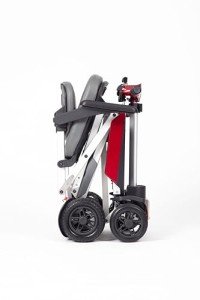
Modern scooters often feature one-touch folding systems. Some utilize a manual pull-lever that collapses the unit in seconds, while others are equipped with remote-controlled automatic folding features. This eliminates the need for the user to bend over or use significant force, making it accessible for those with limited dexterity.
3. Enhanced Comfort and Ergonomics
Because these scooters are designed for longer journeys, comfort is paramount. This includes adjustable tillers, padded seating, and often specialized suspension systems (front, rear, or both) to dampen the vibrations from uneven sidewalks or cobblestones.
4. Intelligent Braking and Safety
Safety is a core priority. These scooters typically feature electromagnetic braking systems that engage automatically when the user releases the throttle. Additionally, integrated LED lighting for both the front and rear ensures visibility during evening use.
Technical Specifications: A Comparative Look
To understand the value of a high-range compact scooter, it is helpful to compare it against traditional travel models. The following table highlights the typical differences.
Table 1: Standard Travel Scooter vs. High-Range Folding Scooter
| Feature | Standard Travel Scooter | High-Range Folding Scooter |
|---|---|---|
| Average Range | 8 – 12 Miles | 20 – 25 Miles |
| Battery Type | Sealed Lead Acid (SLA) | Lithium-Ion (Li-ion) |
| Folding Style | Often requires disassembly | Truly foldable (single piece) |
| Average Weight | 80 – 110 lbs (assembled) | 45 – 65 lbs |
| Top Speed | 3.5 – 4 mph | 4 – 5 mph |
| Best For | Short trips, indoor use | All-day travel, outdoor adventures |
The Impact on Daily Life and Travel
The introduction of a 25-mile range on a portable frame changes the lifestyle calculations for many individuals.
Travel and Tourism
For the avid traveler, a 25-mile range removes "range anxiety." One can navigate an entire airport, board a cruise ship, explore various ports of call, and return to their cabin without worrying about a dead battery. While many airlines have restrictions on battery size (typically 300Wh for lithium batteries), many manufacturers offer "airline-safe" battery swaps that still provide significant, if slightly reduced, range.
Social and Community Engagement
Often, those with limited mobility find themselves withdrawing from social activities because they fear their equipment won't last the duration of an event. A long-range scooter facilitates attendance at outdoor weddings, long afternoons at the zoo with grandchildren, or community festivals where charging outlets are unavailable.
Independence in Commuting
In urban environments, these scooters can serve as a primary mode of "last mile" transportation. A user can ride their scooter to a bus or train station, fold it up for the transit leg, and then ride the remaining distance to their office or doctor’s appointment.
Choosing the Right Model: Essential Considerations
While the range is a headline feature, a prospective owner must consider other technical aspects to ensure the scooter meets their specific needs.
Table 2: Model Selection Criteria
| Factor | Description | Why it Matters |
|---|---|---|
| Weight Capacity | The maximum weight the scooter can safely carry. | Ensures stability and prevents motor strain. |
| Turning Radius | The amount of space needed to perform a U-turn. | Critical for indoor use or crowded hallways. |
| Ground Clearance | The distance between the ground and the undercarriage. | Determines the ability to clear thresholds and small curbs. |
| Tire Type | Solid (puncture-proof) vs. Pneumatic (air-filled). | Solid tires require less maintenance; pneumatic offer better cushioning. |
Maintenance and Longevity
To maintain a 25-mile range over the lifespan of the scooter, proper care is essential. Unlike older battery types, lithium-ion batteries prefer "topping off" rather than being fully depleted. Owners are encouraged to charge the battery after every use. Storage also plays a role; keeping the scooter in a climate-controlled environment prevents the battery cells from degrading due to extreme heat or cold.
Pros and Cons of Long-Range Folding Scooters
The Advantages (Lists)
- Freedom of Movement: Allows for extended trips without the need for midday charging.
- Space Efficiency: Folds down to the size of a large suitcase, making it ideal for small apartments or modest car trunks.
- Modern Aesthetics: Often features a sleek, automotive-inspired design.
- Simplified Transport: No need for expensive van lifts or specialized hitch carriers.
The Trade-offs
- Initial Cost: The advanced battery and lightweight materials often result in a higher price point than basic models.
- Battery Regulations: Large capacity batteries may require additional documentation for air travel.
- Ground Clearance: Because they are compact, they may not be suitable for heavy "off-roading" on thick grass or deep gravel.
Frequently Asked Questions (FAQ)
How long does it take to charge a 25-mile range battery?
Typically, a full charge for a high-capacity lithium-ion battery takes between 4 to 8 hours. Most users choose to charge their scooters overnight to ensure they are ready for the next day.
Can these scooters be taken on airplanes?
Many folding scooters are designed for travel; however, the FAA and other international aviation bodies have specific limits on lithium battery capacity (usually measured in Watt-hours). If the 25-mile battery exceeds these limits, many manufacturers provide a smaller, travel-certified battery as an accessory.
Do I need a specialized vehicle to transport a folding scooter?
No. One of the primary benefits of a compact folding scooter is that it can fit into the trunk or backseat of almost any standard passenger vehicle, including compact cars and taxis.
How do I maintain the 25-mile range over time?
To preserve battery health, avoid letting the battery reach 0% charge. Store the scooter in a cool, dry place, and ensure the tires are properly inflated (if they are pneumatic) to reduce rolling resistance.
Is assembly required when the scooter arrives?
Most compact folding scooters arrive 95% to 100% assembled. The user generally only needs to unpack the unit, unfold it, and ensure the battery is fully charged before the first use.
The compact folding mobility scooter with a 25-mile range is more than just a piece of medical equipment; it is a tool for empowerment. By successfully merging the portable nature of folding designs with the long-lasting endurance of modern battery technology, manufacturers have removed the primary barriers to independence for many individuals. Whether it is used for navigating the halls of a local grocery store or exploring the streets of a distant city, this class of scooter ensures that the journey doesn't have to end until the user is ready. For those seeking a blend of convenience, performance, and reliability, the long-range folding scooter stands as a premier choice in modern mobility.