




The landscape of personal transportation is undergoing a radical transformation. For decades, individuals with limited mobility were forced to choose between heavy, cumbersome power chairs or lightweight scooters that lacked range and advanced safety features. However, a new era has arrived with the introduction of the lightweight 20-mile autopilot 4-wheel mobility scooter.
This innovative category of transportation blends aerospace-grade materials with cutting-edge artificial intelligence to offer a level of independence previously thought impossible. By integrating long-range battery technology with autonomous assistance, these scooters are not merely mobility aids; they are sophisticated travel companions designed for the modern world.
The Evolution of Portability: Engineering the Lightweight Frame
One of the primary hurdles in mobility scooter design has historically been the trade-off between durability and weight. Traditional scooters capable of traveling long distances often required heavy lead-acid batteries and reinforced steel frames, making them nearly impossible to transport without specialized vehicle lifts.
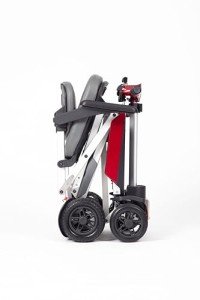
The modern 20-mile autopilot scooter solves this through the use of advanced materials. Utilizing magnesium alloys and aircraft-grade aluminum, manufacturers have managed to keep the total weight of these units—excluding batteries—well under 60 pounds.
Key Factors in Lightweight Design:
- Modular Construction: Many models allow the scooter to be disassembled into three or four lightweight components in seconds.
- Carbon Fiber Accents: Strategic use of carbon fiber provides high tensile strength without adding bulk.
- Lithium-Ion Integration: Replacing heavy lead-acid batteries with high-energy-density lithium-ion cells reduces weight significantly while extending the life of the vehicle.
The Intelligence Factor: Understanding "Autopilot" in Mobility
The inclusion of "autopilot" technology represents the most significant leap forward in the industry. While users remain in primary control, the autopilot system acts as a digital co-pilot, enhancing safety and ease of use. This technology typically relies on a suite of sensors, including ultrasonic transducers and sometimes LiDAR (Light Detection and Ranging).
Autopilot and Smart Features Include:
- Obstacle Avoidance: Sensors detect pedestrians, curbs, or walls, automatically slowing the scooter or bringing it to a gentle stop to prevent collisions.
- Path Correction: On uneven terrain or slanted sidewalks, the autopilot system can make micro-adjustments to the steering to ensure the scooter maintains a straight path without constant manual correction.
- Remote Summoning: Using a smartphone app or a dedicated remote, users can "call" the scooter from a short distance, allowing it to navigate autonomously to their location in a parking lot or living room.
- Speed Regulation on Inclines: The AI monitors the grade of the terrain, automatically increasing power on uphills and engaging electromagnetic braking on downhills to maintain a consistent, safe speed.
Performance and Specifications
To understand the balance of power and portability, it is essential to look at the technical specifications that define this class of mobility scooter. These devices are designed to bridge the gap between "around-the-house" portability and "all-day-excursion" reliability.
Technical Specifications Overview
| Feature | Specification Details |
|---|---|
| Maximum Range | Up to 20 Miles (32 km) per charge |
| Total Weight | 55 lbs - 75 lbs (depending on configuration) |
| Weight Capacity | 250 lbs - 300 lbs |
| Top Speed | 4 mph - 5 mph (standard) |
| Battery Type | 24V or 36V Lithium-Ion (Quick-swap capable) |
| Turning Radius | 45 - 52 inches |
| Ground Clearance | 2.5 - 3.5 inches |
| Charging Time | 4 - 6 hours for a full charge |
The Advantage of Four Wheels
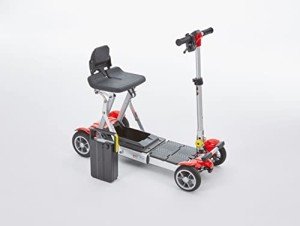
While 3-wheel scooters offer a tighter turning radius, the 4-wheel configuration is the gold standard for outdoor and long-range travel. The 20-mile range capability suggests that the user will be navigating varying environments—from paved mall floors to gravel paths or uneven park trails.
Why 4-Wheel Stability Matters:
- Center of Gravity: Four wheels provide a broader base, significantly reducing the risk of tipping during sharp turns or while traversing inclines.
- Weight Distribution: Improved distribution of the user’s weight reduces wear on individual tires and increases the lifespan of the motor.
- Driver Confidence: The "planted" feel of a 4-wheel scooter allows users to feel more secure when navigating busy urban environments or crowded festivals.
Battery Longevity and Range Management
Achieving a 20-mile range on a lightweight frame is a feat of modern electrical engineering. Lithium-ion batteries are the heart of this achievement. Unlike traditional batteries, lithium-ion cells maintain a consistent power output until they are nearly depleted, meaning the scooter won't "sluggishly" crawl home when the battery is at 20%.
Furthermore, most autopilot scooters feature regenerative braking systems. This technology captures kinetic energy during braking or downhill coasting and funnels it back into the battery, effectively extending the range beyond what a standard motor could achieve alone.
Comparison: Traditional vs. Autopilot Lightweight Scooters
| Feature | Traditional Lightweight Scooter | Autopilot 20-Mile Scooter |
|---|---|---|
| Safety | Manual braking only | AI-assisted collision avoidance |
| Range | 6 - 10 miles | 18 - 22 miles |
| Portability | High (often folds) | High (folds or disassembles) |
| Terrain Handling | Limited to flat surfaces | Versatile (Outdoor/Urban) |
| User Effort | Constant manual steering | Reduced effort via path correction |
| Price Point | Budget-friendly | Premium investment |
The Impact on Daily Life
The move toward lightweight, intelligent mobility solutions has a profound impact on the quality of life for seniors and individuals with disabilities. The ability to travel 20 miles on a single charge means a user can leave their home, visit a local park, go to the grocery store, and meet friends for dinner without ever worrying about a dead battery or needing a ride.
The "autopilot" features specifically lower the barrier to entry for individuals who may have reduced reaction times or hand strength. By automating the more strenuous aspects of navigation and safety, the scooter removes the anxiety often associated with being out in public.
Frequently Asked Questions (FAQ)
1. Is the 20-mile range realistic for outdoor use?
Yes, though range can vary based on the user's weight, the terrain, and the ambient temperature. On flat, paved surfaces with a rider of average weight, these scooters are designed to meet or even exceed the 20-mile mark.
2. Can these scooters be taken on airplanes?
Most lightweight scooters use lithium-ion batteries. While the scooter itself is usually allowed, the battery must meet FAA and IATA regulations (typically under 300Wh). Users should always check with their airline and ensure they have a "Travel-Safe" battery certificate.
3. How does the autopilot handle crowded areas?
The autopilot’s obstacle avoidance system uses sensors to detect movement in its path. If a pedestrian steps in front of the scooter, the system will apply the brakes immediately. It is designed to act as a safety buffer, not to replace the driver’s awareness entirely.
4. How much maintenance do these scooters require?
Because they use brushless motors and solid or honeycombed tires, maintenance is minimal. The primary requirement is keeping the battery charged and ensuring the sensors are clean of dirt or debris so the autopilot functions correctly.
5. Are 4-wheel scooters difficult to maneuver indoors?
While they have a slightly larger turning radius than 3-wheel models, modern design has minimized this gap. Most 20-mile scooters are slim enough to fit through standard door frames and can navigate most hallways and store aisles with ease.
The lightweight 20-mile autopilot 4-wheel mobility scooter represents a peak in inclusive design. By combining the portability of a folding frame with the endurance of a long-range cruiser and the safety of artificial intelligence, it offers a comprehensive solution for those refusing to let mobility challenges slow them down. As technology continues to advance, these vehicles will only become more integrated into the fabric of daily life, proving that independence is a journey that everyone should be able to take.